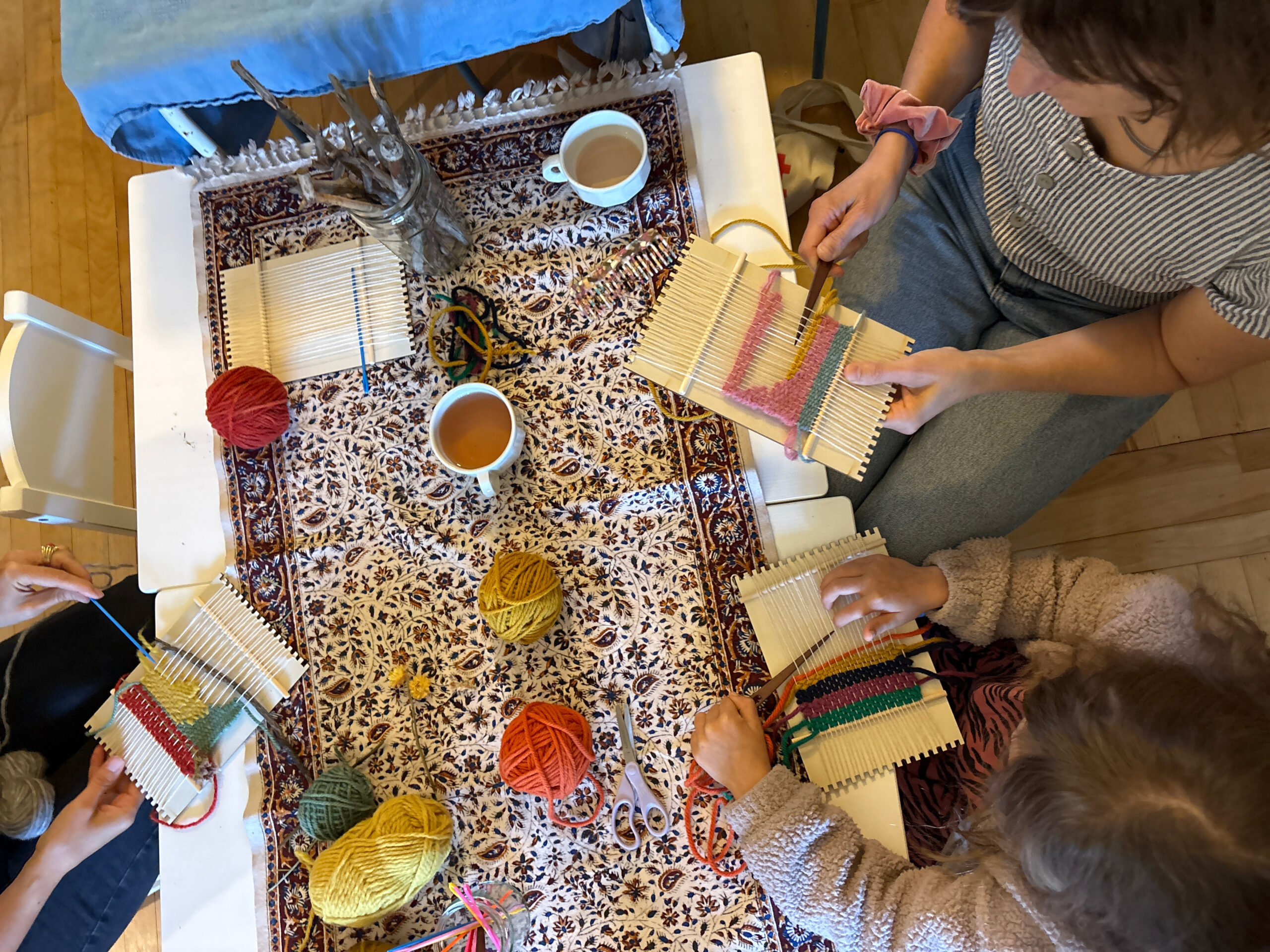

Parent–child workshops are not just another activity or event added to the family schedule. They are a relational experience, a space where time slows down and where parents and children, sitting side by side, each with their own materials, pace, and gesture, enter into a shared act of making: creating embroidery, weaving, experimenting with dyeing, etc.
By offering yourselves these shared spaces, you support not only your child’s development, but also the parent–child bond and the vitality of the educational community as a whole.
Guided by the teacher, hands work alongside one another, gestures echo and respond. These moments embody our approach. They remind us that education lives in doing, in rhythm, and in the quality of presence.
Learning Through Living Imitation
Research in neuroscience shows that children learn largely through observation and imitation. Specialised brain mechanisms enable them to deeply integrate the gestures, attitudes, and inner states of the adults around them.
This living mirror, combined with the freedom to create without judgment, forms essential ground for a child’s creativity, confidence, and capacity to remain engaged in an activity and to immerse themselves fully in it.
A meaningful experience
When a parent creates with their hands and engages wholeheartedly and with presence in the creative process, the child internalize more than just technical gesture. They absorb a way of being in the world: taking time, persevering without rushing toward an outcome, remaining present, and finding joy in the journey rather than the final result.
Free from the Pressure of Results
When parents agree to let go of the idea of achieving a specific result, children feel safe and validated, no longer needing to “do it right.” They are free to do it in their own way. The workshop then becomes a space where gesture is free, abd creativity can unfold without judgment.
Seeing their parent create in this context, fully engaged, sometimes hesitant, often joyful, surprised by their own creation, allows the child to encounter an adult who is a living model, not idealized, but deeply human: an adult guided by exploration and pleasure.
The child then understands that trial, error, and adjustment are an integral part of the process. This experience nourishes their confidence and supports their freedom to act. It is a deeply formative experience for the child.
Nurturing the Parent–Child Bond
Together, parent and child discover the joy of meaningful doing, because it is experienced together. Creating together weaves a bond beyond words. It is sharing a common attention, a gesture, a silence. These simple but deeply nourishing moments leave a lasting imprint on the child’s emotional memory.
Often, long after the workshop, it is not the object that remains, but the memory of a parent who was present, available, and engaged: a memory that nurtures the child’s sense of security and belonging.
Montreal – January 11, 2026 – Prune Desgeorges
« Lire ainsi l’autre, c’est favoriser sa respiration, c’est à dire le faire exister. »
Christian Bobin, écrivain et poète français contemporain,
extrait de son livre “La lumière du monde”.