
~ Anke Scheinfeld & Prune Desgeorges
“Children are incredible imitators. Mimicry paves the way to their further development. Imitation is the start of the cultural process of becoming human.”
~ Markus Paulus
1. It is a sunny tuesday morning in the early days of spring.
Here in Manhattan’s East Village, little children enter their nursery classroom, where I am their teacher. They take off their shoes, put on their slippers, wash their hands, and say goodbye to their caregivers. With enthusiasm, they each bring a little bag to the communal table where one of their teachers is already at work. In each bag is their special offering, a vegetable of their choosing. On this morning, celery, yams, broccoli, corn, carrots, fennel, mushrooms, and herbs are shared.
The children find a place at the table and join in preparing our morning meal of vegetable soup. Peeling, chopping, and slicing are all done with paring knives and peelers. Everyone knows what to do. Soon, the room is filled with the delicious aroma of simmering soup. The children then move freely from work to play. In the play area, houses are built and furnished. Meals are prepared in the play kitchen as well, and tables are set for everyone to join at mealtime. The mood is lively yet peaceful, until a playhouse wall crumbles with a blaring noise, and one friend’s foot is injured by a falling block. Caring friends rush to the rescue with a glass of water, an ice pack, and arnica cream. By springtime, the flow of the morning has been well established. The children feel confident and relaxed and are open to the experiences of the morning.
“Children have never been very good at listening to their elders, but they have never failed to imitate them.”
~ James Baldwin
2. Do the children still imitate?
Is this capacity still present in our time? Early childhood educators are observing a change in the way children engage with their environment. In my classroom, I have observed children relate to the world in more extreme ways than before: some with great hesitation and precocious self consciousness and others with fearless engagement that lacks attention, displaying incomplete maturation of sensory and motor skills. Why are our children no longer imitating us? What are children now experiencing in their environment, and how does this influence their development? What do we know about their capacity to imitate and its importance in their healthy growth?
“Imitation is not just the sincerest form of flattery – it’s the sincerest form of learning.”
~ George Bernard Shaw
3. Imitation is widely acknowledged as a key aspect of learning.
The ancient Greek philosopher Aristotle regarded imitation as a distinctive aspect of human nature, humans being the most imitative of all creatures. Researchers in the fields of experimental child psychology, developmental psychology, educational psychology, and neuroscience are exploring underlying mechanisms of imitation, and investigating whether imitation is innate or acquired. In these studies, the term “imitation” refers to the ability to learn to perform an action and the way to achieve it by reproducing both observed goals and gestures. Many questions are still unanswered, but the consensus is that imitation is a crucial learning mechanism in humans that allows for the rapid transfer of knowledge between individuals, especially in early childhood. It was also discovered that the caregiver plays a key role in the process of imitation. Some researchers even found evidence that imitation in toddlers is increased when caregivers imitate the toddler. It is not yet understood if specific brain regions or neurons are responsible for the capacity to imitate.
4. Rudolf Steiner spoke repeatedly of imitation, especially in his lectures on education and developmental psychology.
He emphasized the crucial role imitation plays in learning during the first seven years of life. Arising naturally out of contemplating these theories is the question: what kind of environment do young children need to optimize their ability to imitate?
“In raising children, we need to continuously keep in mind how we can best create the most favorable environment for their imitative behavior. Everything done in the past regarding imitation must become more and more conscious and more and more consciously connected with the future.”
~ Rudolf Steiner
This inspires us to repeatedly consider the environment we create in our classrooms. Understood in its widest possible sense, environment here includes physical, temporal, emotional, social, moral, and psychological aspects. In my own case, the first step on my path was to pause! This is easier said than done because I am busy with classroom preparations, moving with the children through daily, weekly and seasonal rhythms, and cleaning up after dismissal. When I stay attuned to the children, though, they awaken me to their true needs. I try to pay close attention to situations where the children are unable to enter into the morning flow. When I recognize old patterns no longer work, I adjust my approach. I learned that my unrushed presence and mindful attention provided the essential starting point in cultivating a classroom that feels calm, connected, and supportive of children’s development.
5. Young children have individual needs at each stage of development, yet they all need nurturing care, a gentle unfolding of the day, authentic adult presence, meaningful activities, and manageable expectations.
I wondered how I could satisfy their needs in a natural and selfless way. Carefully planning rhythmic, daily and seasonal activities, and circles and transitions were already part of my preparatory work, but more was required.I found that when I created a calm, unhurried atmosphere, the children responded in the same way. I stopped wearing a watch and instead relied less on the clock and more on the natural rhythm of the day. Over time, I developed a better sense of the group’s needs and flow. At times, I allow the children the luxury of extra free play, and then move more swiftly through other parts of the morning. This awareness of the group’s natural rhythm brought a flowing pace to our days. The children entered a state of relaxed focus in their play or work. The children not only started imitating more activities of the adults, but also their mindful inner attitude. Domestic activities help create a sense of rhythm and stability through repetitive, meaningful, and comprehensible tasks. They create a form within which children can explore freely.
6. Another requisite for imitation is attention.
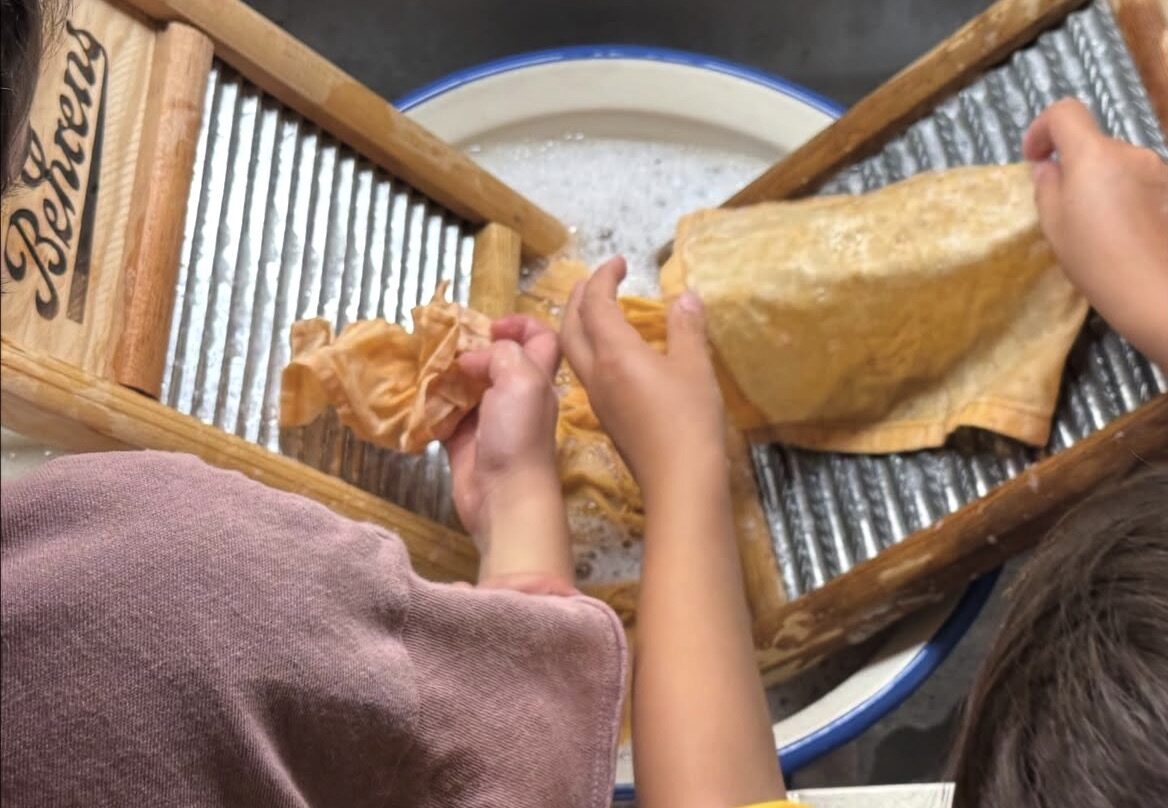
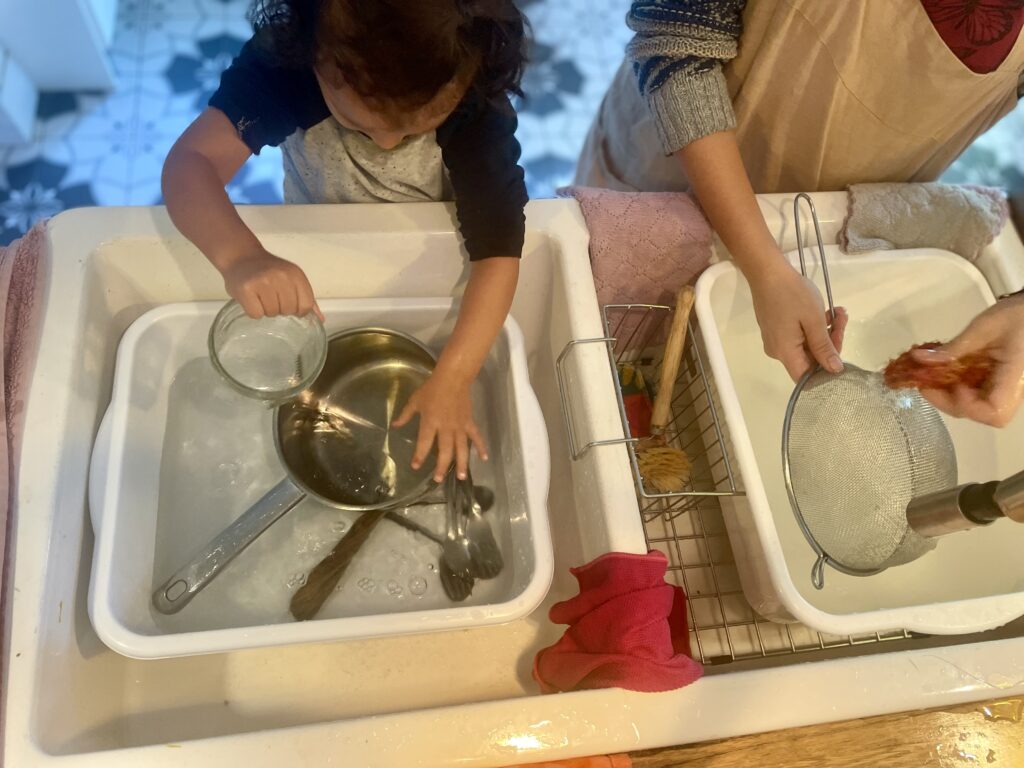
The ability to be joyfully attentive to my work while also attuned to my surroundings needed cultivation. To develop this, I explored the idea of ‘point and periphery’ not only intellectually, but also through drawing, painting, sculpting, and movement. Through this practice, I learned to experience myself simultaneously as center and periphery, while authentically staying present in my work. I realized that activities I enjoyed, and that came naturally to me in the presence of children, drew the children to me. They then desired to do the same things. I gave myself the task of bringing the same joyful presence to the activities that I had usually performed more systematically. I was delighted to see that, with a change in my attitude, the children’s attitude also changed. Sweeping the floor, washing laundry, and cleaning dishes became new favorites for all.
Changing the approach to activities that I performed quickly by myself, because I thought they were too difficult for children, was the next step. Setting up for painting was one such task. I placed the painting boards, glass jars, paints, brushes, and painting cloth within reach of the children and began to set the table. The children were immediately interested and delighted that they could participate in pouring water and paint into little jars and setup painting boards for all. There was a clear order to the process and the children helped each other. They earnestly cooperated and even cleaned up the accidental spills of water or paint. Soon, I had enthusiastic and capable helpers who proudly experienced competency and ownership of this task. Painting became more meaningful and clean-up afterwards was carried out by our young helpers as well. Integrating all aspects of an activity like painting, by allowing children to participate in the whole process, strengthened the overall atmosphere. The children experienced meaning in doing, on a physical rather than intellectual level. Guided by the children themselves, I learned more through these experiences, and wondered what barriers to imitation they encounter as they pass from one developmental stage to the next.

7. If we consider that imitation is a treasure children bring with them at birth, we adults are the guardians of this treasure.
We control and care for the environment into which they enter with open hearts and full of truth. We honor this trust bestowed upon us by striving to be more mindful of time, space, form, and relationships. Children are born into a world that is constantly changing. Reflecting on our own childhood experiences allows us to gain a deeper understanding of the young child’s perspective and development.
My childhood memories are filled with sensory experiences. These are often memories of special smells associated with experiences in nature or at home. I can recall how my heart started to beat faster when I smelled the odor of fresh cow dung, anticipating the cows running out of the forest towards the meadow. I felt happy and safe when smelling the meat roasting in my grandmother’s oven, looking forward to a delicious meal shared with grandparents, parents, siblings, aunts, uncles, and cousins. Gazing into the starry heaven on a cold winter night while in the warm embrace of my mother brought a paradox of sensations, the enormity and closeness of the universe. My senses were nurtured in childhood. I was fortunate to have the freedom to explore the world while still protected by the culture and society into which I was born.
8. Is there still a protective sheath for our young children today, within which they can mature their senses and will themselves into this world ?
The harshness of our culture today tears at this sheath, and it is our charge to repair it. Community and nature are still the essential elements of renewal, as they were during my childhood. Children feel homeless in our material world overloaded with sensory stimuli, which is pushing them faster and faster into an intellect dominated culture they are not ready for. But they still can find a sense of wonder and meaning in their experiences. They want to guide us to give them what they need to engage with the material world. I am continuously learning to listen to their message and to see them for who they are.
“Through others we become ourselves.”
~ Lev S. Vygotsky
It is inspiring as much as it is a relief to observe that, as children are born into our modern world, they still bring the treasure of imitation with them, guiding us to create for them the most nurturing environment. Supporting a balanced rhythm of activity and rest, attention and engagement, structure and freedom, helps children remain in a flow state with the world. This focused state allows them to fully absorb their experiences, bridging moments of reflection and active participation.
Children need to meet the real world in a way that greets their capacities at each developmental stage. The real world is beautiful and challenging at the same time. Pain is real and so is joy. Childhood is the time to grow into this complex and paradoxical world step by step. We can be guides on the children’s path. We need the courage to slow down, pause, and take time for observation, contemplation, and learning.
Dr. Anke Scheinfeld is teacher of children aged 3-6 years in the Linden Class at New Amsterdam School in the East Village of NYC and is co-founder of Centre Pastel with Prune Desgeorges. She has been a Waldorf early childhood educator for two decades. She received her MA in Early Childhood Waldorf Education from Sunbridge Institute. Prior to teaching, Anke worked as a physician and researcher in Germany, Great Britain, and the USA.
An astute observer, she describes the joy of witnessing natural imitation of young children as they delight in the exploration of their world.
This article was written by Anke Scheinfeld and Prune Desgeorges